Artikel: Black Onyx vs. Black Rutilated Quartz Rings: Which Dark Gemstone Should You Choose?

Black Onyx vs. Black Rutilated Quartz Rings: Which Dark Gemstone Should You Choose?
A dark gemstone ring can feel modern, romantic, architectural or quietly unconventional. Yet two stones that look similar in a product filter can create very different experiences on the hand. Black onyx gives you a smooth, solid field of black. Black rutilated quartz lets light move through a web of dark natural inclusions.
Neither is a substitute for the other. The better choice depends on whether you value visual consistency or one-of-a-kind variation, how often the ring will be worn, which setting you prefer and how comfortable you are with mindful care.
This guide compares black onyx and black rutilated quartz as ring stones so you can choose by real differences—not simply by the word “black.”
The Short Answer
Choose black onyx if you want a polished, opaque black gemstone with a clean silhouette and strong contrast against gold. It suits minimal, vintage, signet-inspired and bold geometric designs.
Choose black rutilated quartz if you want a translucent or smoky gemstone with visible dark needles, natural movement and a pattern that will not look exactly like another stone. It is especially compelling in elongated, geometric and nature-inspired settings.
Both require more care than diamond, sapphire or moissanite. For an engagement ring, the setting and wearing habits are just as important as the gemstone name.

What Is Black Onyx?
Onyx is a variety of chalcedony, the microcrystalline form of quartz. Traditional onyx can show parallel bands, but the jewelry trade commonly uses “black onyx” for material with a uniform or near-uniform dark appearance. Its surface is often polished to a high gloss, producing a mirror-like black rather than visible internal sparkle.
Commercial black onyx may be treated to create or improve its even color. Treatment is not automatically a problem, but it should be disclosed because it can influence cleaning advice and expectations. If origin or treatment matters to you, ask before ordering rather than assuming the color is completely untreated.
What Does Black Onyx Look Like in a Ring?
Black onyx is opaque: light reflects from the polished surface instead of traveling through the center. That makes the outline of the cut especially important. Oval and pear cabochons feel smooth and sculptural; kite, hexagon and coffin shapes feel graphic; a flat-topped stone can create a more architectural impression.
Its consistency is part of the appeal. Although natural material and polish can vary, black onyx generally offers a more uniform visual result than an inclusion-rich stone. Customers who want the product to read as clearly black from across the room often prefer onyx.
Explore GemifySpace Black Onyx Rings for opaque black centers, dark accents and coordinated ring sets.
What Is Black Rutilated Quartz?
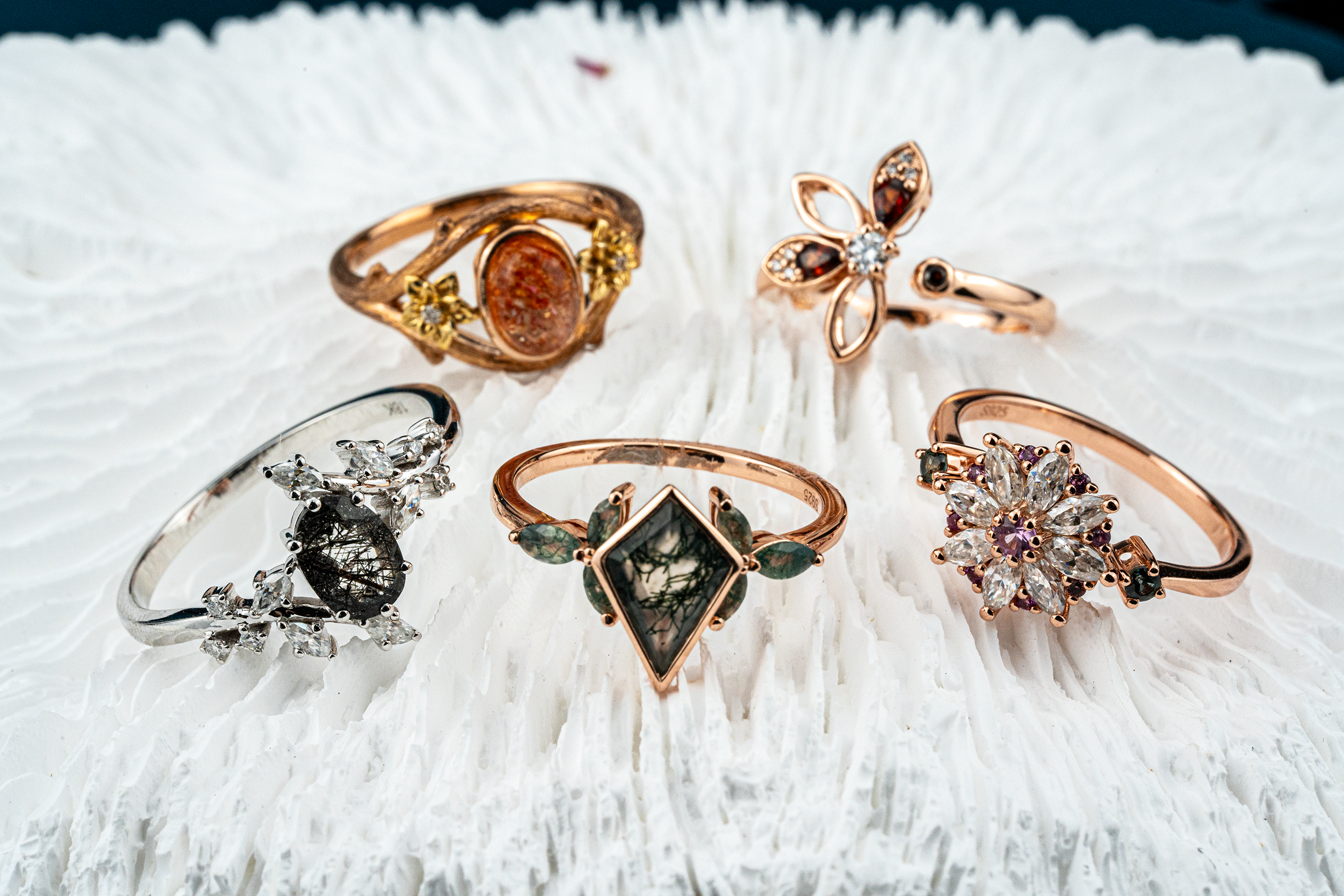
Rutilated quartz is quartz containing needle-like inclusions of rutile, a titanium dioxide mineral. In material sold as black rutilated quartz, those internal needles appear dark gray, brown-black or black against a clear, cloudy or smoky quartz body.
The inclusions may form fine parallel strands, dense crossing lines or open patterns with large transparent areas. They are not surface decoration. They grew inside the quartz, creating depth that changes as the ring moves through light.

Why Does Every Black Rutilated Quartz Look Different?
Inclusion density, direction, thickness, background tone and cut all affect the finished appearance. One stone may look airy and transparent; another may appear dramatically webbed or nearly smoky. A listing image should therefore be treated as a design reference rather than a promise that every natural center will have identical lines.
If you want a very specific balance of transparency and dark needles, request a stone photo when that service is available. Natural variation is the feature—not a defect to be edited away.
Browse GemifySpace Black Rutilated Quartz Rings to compare elongated hexagons, ovals, three-stone designs and matching sets.
Image placement: Insert black-gemstone-appearance-comparison.png after this paragraph.
ALT: Opaque black onyx and translucent black rutilated quartz gemstones with matching gold rings on ivory stone.
Black Onyx vs. Black Rutilated Quartz: Key Differences
| Feature | Black Onyx | Black Rutilated Quartz |
|---|---|---|
| Visual character | Solid, smooth and opaque | Transparent to smoky with dark internal needles |
| Variation | Usually more visually consistent | Every inclusion pattern is different |
| Light behavior | Surface reflection | Light moves through and around inclusions |
| Typical ring mood | Minimal, graphic, vintage or bold | Organic, mysterious, geometric or nature-inspired |
| Mohs hardness | About 6.5–7 | About 7 for the quartz host |
| Buying priority | Polish, even color, cut and treatment disclosure | Inclusion pattern, transparency, cut and structural condition |
| Care level | Mindful care; avoid abrasion and harsh chemistry | Mindful care; protect from impacts and inspect inclusion-reaching surfaces |
The numbers are close, but hardness measures scratch resistance—not immunity to chips, cracks or setting damage. An individual stone’s fractures, surface-reaching inclusions, cut and mounting can matter as much as its category.

Which Is Better for an Engagement Ring?
Both can be used for an alternative engagement ring if the wearer understands their care needs. Neither is the lowest-maintenance option for someone who rarely removes jewelry or regularly works with tools, weights, hard surfaces or chemicals.
Choose Black Onyx If You Prefer Consistency
Black onyx is well suited to someone who wants:
- A clearly black center without visible internal pattern
- Strong contrast with moissanite or diamond accents
- A clean oval, pear, kite, hexagon or coffin silhouette
- A polished minimal or vintage-inspired appearance
- A ring that coordinates easily with an all-black wardrobe or classic gold jewelry
Because the stone is opaque, the viewer notices proportion, polish and setting outline immediately. A simple bezel can look intentional rather than plain.
Choose Black Rutilated Quartz If You Prefer Individuality
Black rutilated quartz is well suited to someone who wants:
- A gemstone with a naturally unique internal pattern
- Light and transparency within a dark palette
- An elongated or geometric center stone
- An organic link to leaf, branch, celestial or abstract designs
- A ring that changes in appearance at different angles
It is a strong alternative to uniform black when you want detail that rewards a closer look. The best stone is not necessarily the one with the most needles; it is the one whose pattern, clarity and cut feel balanced to you.
Select a Protective Setting
The setting should protect vulnerable edges without hiding the feature you chose the stone for.
Settings for Black Onyx
A full or partial bezel works naturally with black onyx because it reinforces the clean outline and covers more of the edge. Smooth rounded prongs can also work, particularly when you want more visible gold contrast. Cabochons need even support and secure contact; an oversized stone in a very thin band may feel top-heavy.
Settings for Black Rutilated Quartz
Prongs reveal more of the transparent quartz and allow light to enter from the sides. Elongated hexagons, kites, pears and marquises should have protected points, such as V-prongs or designed metal tips. A partial bezel can add edge coverage while leaving windows of transparency.
Inspect the stone from the side. If a visible fracture or inclusion reaches the surface near a point or prong, ask whether it affects durability. Natural inclusions create beauty, but the structural condition of each stone still deserves attention.
Image placement: Insert protective-settings-for-dark-gemstones.png after this paragraph.
ALT: Low bezel black onyx ring beside a prong-set black rutilated quartz ring with protected hexagon points.
Choose the Gold Color by the Effect You Want
Metal color changes how each dark gemstone reads.
Yellow Gold
Yellow gold creates the warmest contrast. Against black onyx it feels graphic, rich and slightly vintage. Around black rutilated quartz, it can bring warmth to a smoky body and emphasize brown or golden reflections within the stone.
Rose Gold
Rose gold softens both gems. It gives onyx a more romantic tone and can make rutilated quartz feel botanical or celestial. This is a strong pairing for floral shoulders and alternative bridal sets.
White Gold
White gold creates a cooler, cleaner boundary. It supports modern onyx shapes and allows gray-black rutile needles to remain the focus without adding warmth.
Black-Finished Gold
Black-finished gold produces the lowest color contrast with black onyx and the strongest continuous dark silhouette. With rutilated quartz, it can frame the transparent areas while echoing the needles. Because black is a surface finish over real gold, it may show wear and require professional refinishing over time.
See GemifySpace Black Gold Rings for dark-finished settings, or compare broader styling in the Gothic Engagement Ring Guide.
Image placement: Insert dark-gemstone-ring-metal-colors.png after this paragraph.
ALT: Black onyx and black rutilated quartz rings shown in yellow, white, rose and black-finished gold on ivory stone.
Think About Shape and Cut
Black onyx is often beautiful as a cabochon because the curved surface creates a broad reflection and tactile depth. Faceted black onyx can look sharper and more geometric, but it will not display the same internal light return as a transparent faceted gem.
Black rutilated quartz benefits from a cut that organizes its inclusions without making them look crowded. Elongated hexagon and kite cuts can follow strong linear patterns; oval and pear cuts soften irregular needles; a step-style cut can emphasize transparency and architecture.
When comparing sizes, do not rely only on carat weight. These materials may be cut with different depths and silhouettes. Review millimeter dimensions and on-hand scale, especially for elongated stones.
How to Pair Accents and Wedding Bands
Clear moissanite or lab-grown diamond accents add brightness around either stone. With onyx, they create crisp black-and-white contrast. With rutilated quartz, small accents can outline the center without competing with its internal pattern.
Colored accents require restraint. Moss agate can make onyx feel more organic, while amethyst or alexandrite can add a cool color note to rutilated quartz. Repeating too many materials may make the design feel busy, so choose one clear relationship: contrast, color echo or shared shape.
For the wedding band, check profile and outline rather than assuming a straight band will fit. A low bezel, wide hexagon or large pear may need a curved, contour or V-shaped band. Browse GemifySpace Ring Sets when exact alignment matters.
Care for Black Onyx and Black Rutilated Quartz Rings
Remove either ring before exercise, gardening, cleaning, swimming, heavy lifting or work involving impact. Put it in a secure box rather than a pocket or open tray.
For routine cleaning, begin conservatively:
- Use lukewarm water with a small amount of mild soap.
- Wipe gently with a soft cloth or use a very soft brush around the setting.
- Avoid long soaking, abrasive powders and harsh household chemicals.
- Rinse carefully and dry completely with a lint-free cloth.
- Store separately so harder jewelry does not scratch the stone or metal.
Because black onyx may be treated and rutilated quartz may contain surface-reaching inclusions, do not assume ultrasonic or steam cleaning is appropriate. Ask a jeweler who can examine the specific stone and setting.
Have prongs, bezels and accent stones inspected periodically and after a hard knock. Stop wearing the ring if the center moves, clicks or shows a new surface line.
Image placement: Insert black-onyx-rutilated-quartz-ring-care.png after this paragraph.
ALT: Gentle care scene with black onyx and black rutilated quartz rings, mild soapy water, soft brush and lint-free cloth.

Buying Checklist
Before ordering, confirm:
- Do you want opaque consistency or transparent natural variation?
- Is the photographed stone the exact stone you will receive?
- Has the black onyx been treated, and what care is recommended?
- Does the rutilated quartz have surface-reaching fractures near points or prongs?
- Are sharp corners protected?
- What are the center stone’s millimeter dimensions?
- How high does the setting sit above the finger?
- Will a straight wedding band fit, or is a curved band needed?
- Is the black-gold option a surface finish, and how is it maintained?
- Are you comfortable removing the ring for higher-risk activities?
Find Your Dark Gemstone Ring
Black onyx offers clarity of design: one deep, polished field of black. Black rutilated quartz offers natural complexity: dark lines suspended in changing light. One is not more meaningful than the other. The right choice is the one whose visual character and care expectations match the person wearing it.
Compare the Black Onyx Ring collection, Black Rutilated Quartz Rings and the wider Engagement & Wedding Rings collection. Review front and side views, then contact GemifySpace if you need help with natural stone variation, gold color, ring size or wedding-band fit.
Frequently Asked Questions
Is black onyx the same as black rutilated quartz?
No. Black onyx is chalcedony and typically appears opaque and uniformly black. Black rutilated quartz is quartz containing visible dark rutile needles, so it is usually transparent to smoky with an internal pattern.
Which stone is more unique?
Black rutilated quartz normally shows more obvious stone-to-stone variation because every inclusion pattern differs. Black onyx is a better choice when you want a more consistent solid-black appearance.
Which is harder: black onyx or rutilated quartz?
Black onyx is generally about 6.5–7 on the Mohs scale, while the quartz host in rutilated quartz is about 7. The difference is small, and hardness only measures scratch resistance. Cut, fractures, inclusions, setting and impact exposure also affect durability.
Can black onyx be worn as an engagement ring?
Yes, for someone who accepts mindful care. A protective setting and removal during exercise, cleaning and manual work can reduce risk. Buyers should also ask about treatments and cleaning guidance.
Is black rutilated quartz suitable for everyday wear?
It can be worn regularly with care, but it is not damage-proof. Protect pointed cuts, avoid hard impacts and have any surface-reaching features evaluated before purchase.
Does every black rutilated quartz ring look different?
Yes. Needle density, direction, background transparency and cut vary naturally. Ask whether the listing shows the exact stone or a representative example.
What gold color looks best with black gemstones?
Yellow gold gives the strongest warm contrast, rose gold feels softer, white gold looks cool and modern, and black-finished gold creates a continuous dark silhouette. The best choice depends on the desired mood and maintenance expectations.
How should I clean a black gemstone ring?
Start with lukewarm water, mild soap, a soft cloth and a very soft brush around the setting. Avoid abrasives, harsh chemicals and long soaking. Do not use steam or ultrasonic cleaning unless a jeweler confirms it is safe for the exact gemstone, treatment and setting.